
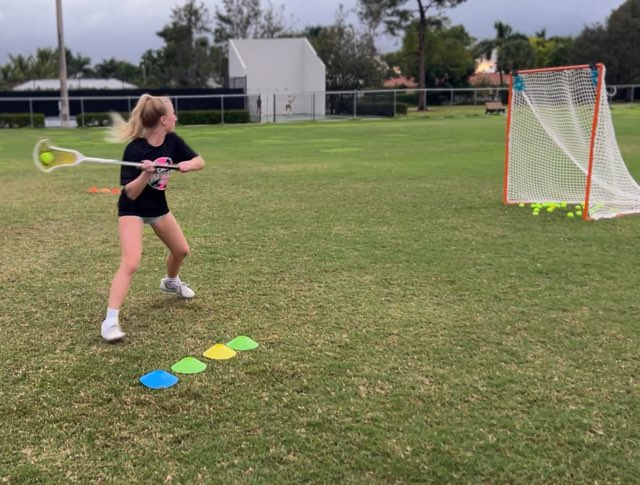
A wall lets a player catch and throw without a partner. It supports coached sessions. It does not replace a coach watching decisions in a game-like setting.
Why wall ball fits between sessions
Group sessions are about an hour and focus on fundamentals. Specialty sessions add 1 to 2 hours of focused training. On the other days, a player can keep the stick in their hands alone. The site does not assign a number of throws.
Beginner lacrosse wall ball drills
Stand a few yards from a solid wall, with open space and nobody in the rebound path. Stop if the ball could hit a person, a window, or a car.
- Strong hand: throw to one spot, catch the return, and repeat. Keep the stick up.
- Weak hand: the same pattern on the other side, at a distance you can actually catch.
- Quick sticks: step closer, soften the throw, and shorten the pause between the catch and the next throw.
Faster routines once the catch is steady
When both hands can catch a straight return, change the throw: over the shoulder, around the side, or a bounce just before the catch. Move your feet between reps so the catch happens on the move. Sore arms are a reason to stop.
How this sits next to a coached hour
Use a short block on days without a session. The group hour is for fundamentals with other players. A specialty session is where 1-on-1 or private-group work goes deeper than a wall can. Neither format publishes a wall-ball homework count.
When the wall stops teaching the game
The wall cannot tell you whether the pass was the right one. When catches feel easy and games still feel rushed, that is a reason to train with a coach. Group sessions focus on fundamentals. Specialty sessions are 1-on-1 or private groups for additional focused training.